The Smith & Wesson N-frame may be one of the most influential double-action revolver platforms ever produced on the American landscape. Its profile is unmistakable, its lineage well documented, and its presence has been felt in holsters, hunting camps, and duty roles for well over a century. If the Colt Single Action Army represents the frontier, the N-frame represents what came after. It is the evolution of the American revolver into something stronger, more capable, and more adaptable.
Introduced in 1908 with the .44 Special Hand Ejector First Model, often referred to as the Triple Lock, the N-frame was designed to handle cartridges that pushed beyond what earlier revolvers could reliably manage. It became the backbone for some of the most important handgun developments in history, including the .357 Registered Magnum and later the .44 Magnum in the Model 29. Through all of its iterations, the N-frame has remained defined by strength, shootability, and the ability to manage serious recoil without compromising accuracy.
That foundation is critical, because everything that follows depends on it.
The Mountain Gun
The original Smith & Wesson Mountain Gun concept emerged in the late 1980s, with the Model 629 Mountain Gun appearing around 1989. It was not simply a lighter revolver. It was a response to a very specific need. Hunters, guides, and outdoorsmen wanted a revolver that could deliver meaningful power without becoming a burden to carry all day.
Advertisement — Continue Reading Below
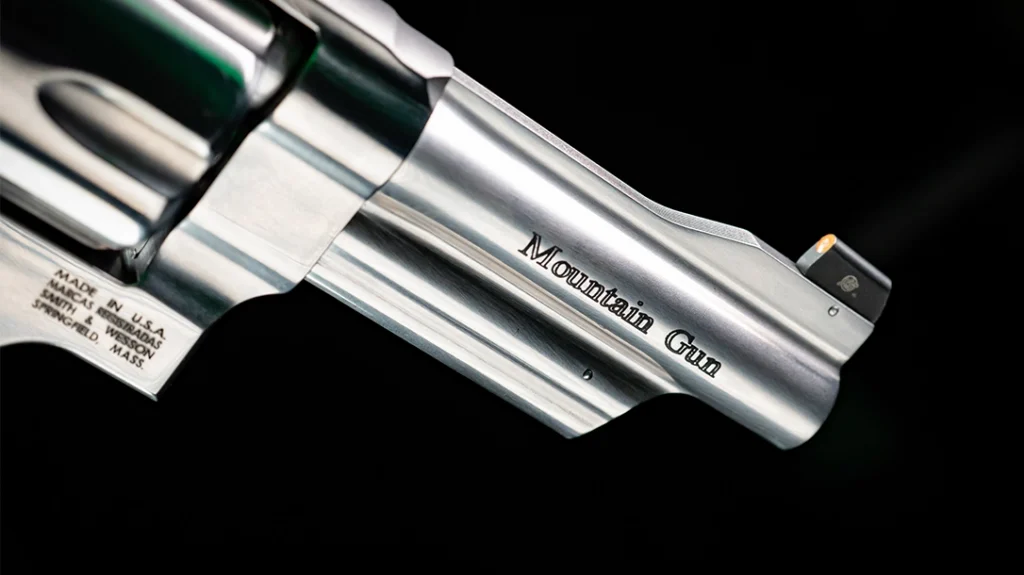
The solution was elegant. A tapered, half-lug barrel removed unnecessary forward weight. Round-butt frames improved carry comfort. Edges were softened, profiles refined, and the revolver became something you could live with on your hip rather than something you tolerated.
By the mid-1990s, the concept expanded across multiple calibers, and the Mountain Gun line became a staple for those who valued practical performance over brute mass. Production eventually slowed and the line faded, but the idea never disappeared, it was just matter of time before it returned.
A New Interpretation
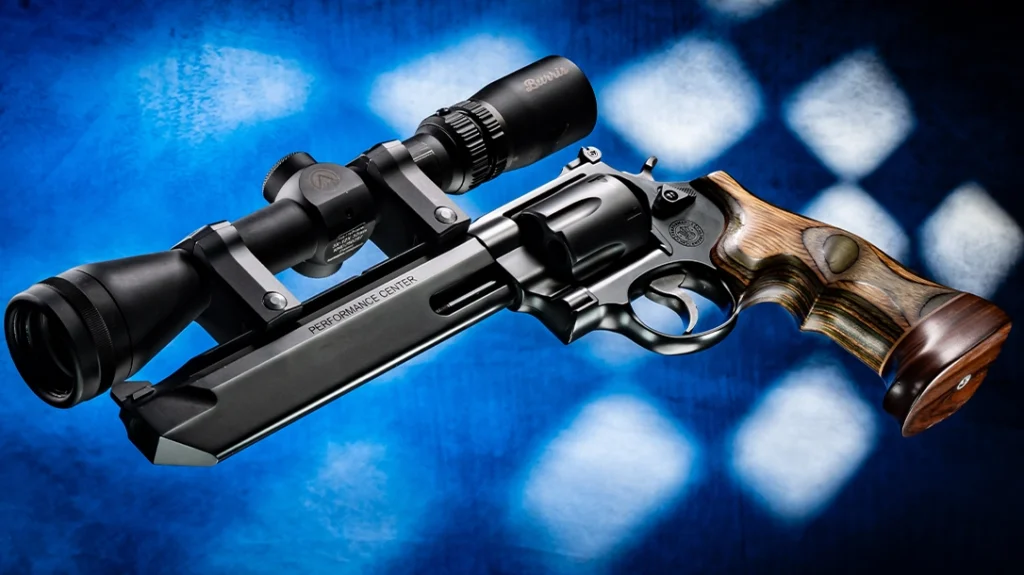
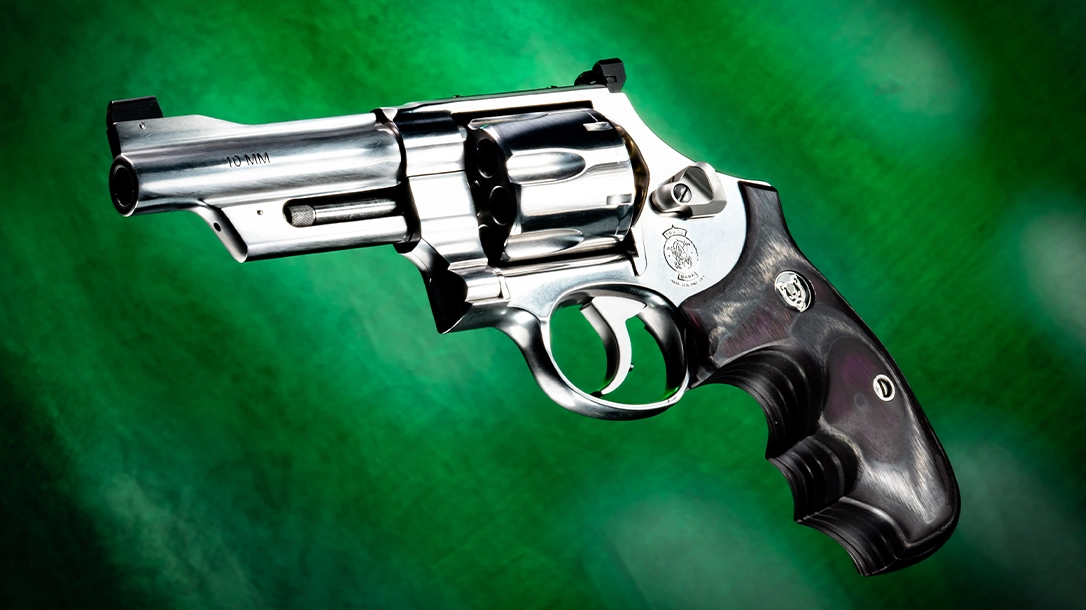
In 2024 and into SHOT Show 2025, Smith & Wesson brought back a series of revolvers that many assumed were simple reissues. Some were. Some were not. One stood out immediately. The Smith & Wesson Model 610 Mountain Gun.
This was not a nostalgic throwback. This was a new SKU. A modern interpretation of the Mountain Gun concept chambered in a cartridge that has become one of the most experimented with cartridges in the industry. The 10mm Auto is not a traditional revolver cartridge. It is rimless, designed for autoloading pistols, and requires the use of moon clips to function in a revolver. These clips hold the cartridges together affixed as a package, allowing for proper headspacing and extraction. In practice, they offer fast reloads and consistent alignment.
In the N-frame, the 10mm finds an interesting home. Its performance envelope sits above .357 Magnum in many configurations and approaches the lower end of .44 Magnum territory, all while maintaining a flatter shooting profile and more manageable recoil. It is a cartridge that rewards control and consistency, and in the right platform, it becomes something special.
Advertisement — Continue Reading Below
Building the “Mountain Fighter”
The factory Mountain Gun is a beautiful revolver. It carries the classic lines, a tapered barrel, a gold bead front sight, and grips that feel right in the hand. It is a nod to the past with the benefit of modern manufacturing. That was not enough for me. I wanted to build something that could live in the concealed carry space while maintaining the power and reliability expected of an N-frame. I wanted a carry revolver and I was going to build it.
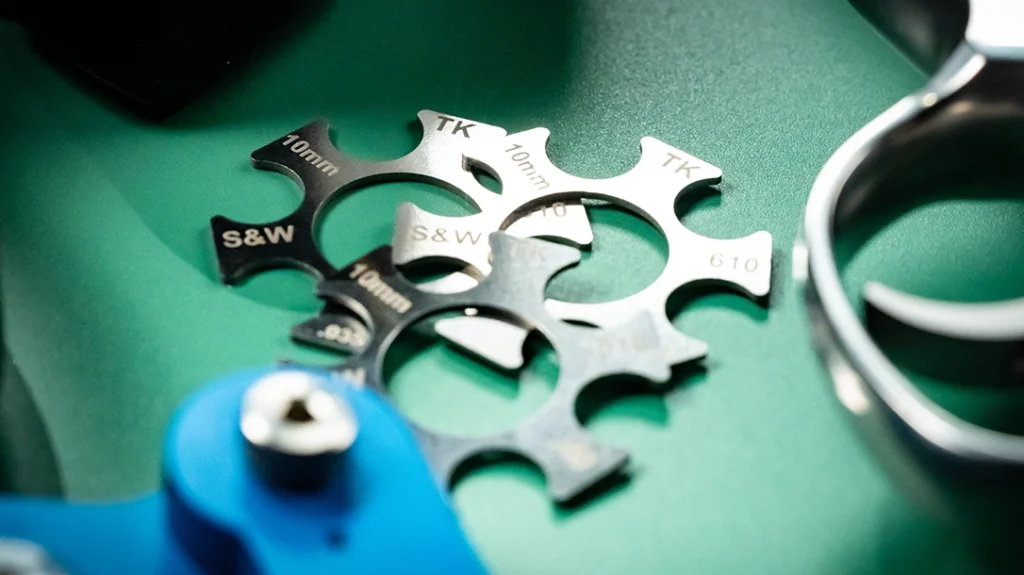
The first call went to TK Custom. The goal was to rework the internal geometry to support a defensive role. Timing from the factory was slightly late. Within acceptable limits, but not where I wanted it. In a revolver, timing is everything. The cylinder must reach full lockup (in double-action) before the hammer falls, regardless of drag or environmental conditions. The solution was an oversized hand, fitted to ensure positive rotation and consistent lockup. From there, an oversized cylinder stop was installed to tighten engagement. This created a lockup that is confident and repeatable.
The action received a full internal overhaul. A bobbed hammer reduced snag potential while maintaining reliable ignition. An extended firing pin and reduced power mainspring ensured consistent primer strikes with a lighter double-action pull. The trigger was refined and paired with a trigger stop, creating that confident trigger feel at the top of the trigger stroke.
I didn’t stop there. The cylinder, yoke and ejector, were all fitted to align perfectly to the bore and maximize reliability. A ball detent was added to the crane, increasing lockup strength under recoil and aiding in quick reloads. The cylinder latch was replaced with a modified profile to aid further in reloading the big Smith.
Advertisement — Continue Reading Below
This is where the gunsmithing for the application is critical. Tight is good. Too tight can be a problem, when the job gets dirty. The balance is found in understanding where movement is required and where it is not. In a carry gun these concepts become more critical.
Control and Interface
Grip selection is critical on a revolver like this. I went with Badger Custom grips to establish a consistent and repeatable hand position. The interface between shooter and gun must be predictable. There is no room for adjustment under stress.
Sights came from XS in the form of their Minimalist system. An Orange front night-sight paired with a U-notch rear creates a sight picture that is fast, durable, and easy to track under recoil. It is not a target sight. It is a fighting sight.
The result is a revolver that presents quickly and returns to target with minimal effort.
Carrying the Platform
The biggest question with a revolver like this is not whether it shoots well. It is whether it can realistically be carried.
Advertisement — Continue Reading Below
As configured, the revolver weighs 2 pounds, 7.4 ounces empty. That is a substantial piece of equipment. For those accustomed to full-size pistols, it is manageable. For others, it is a commitment. Holster selection becomes critical.
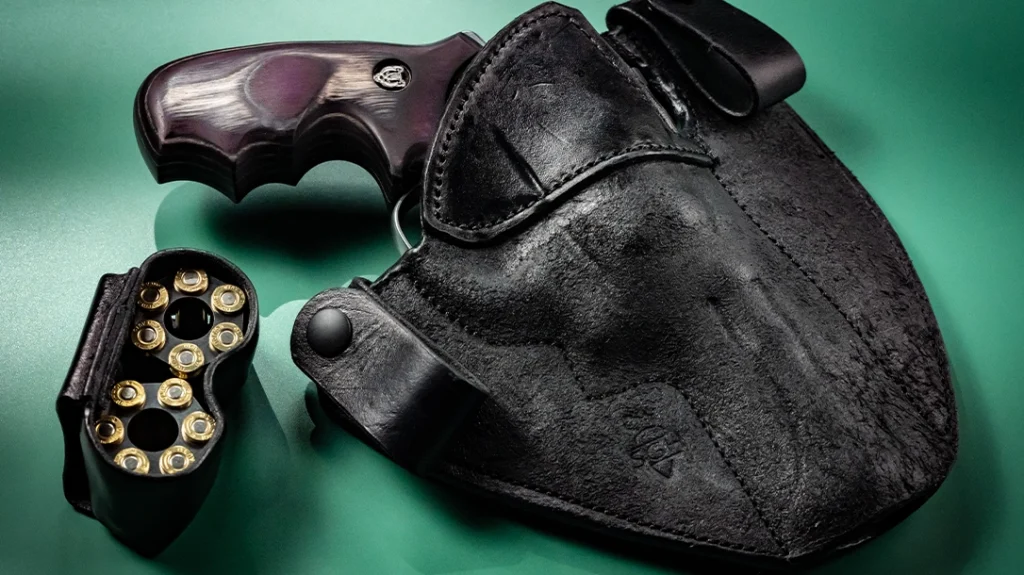
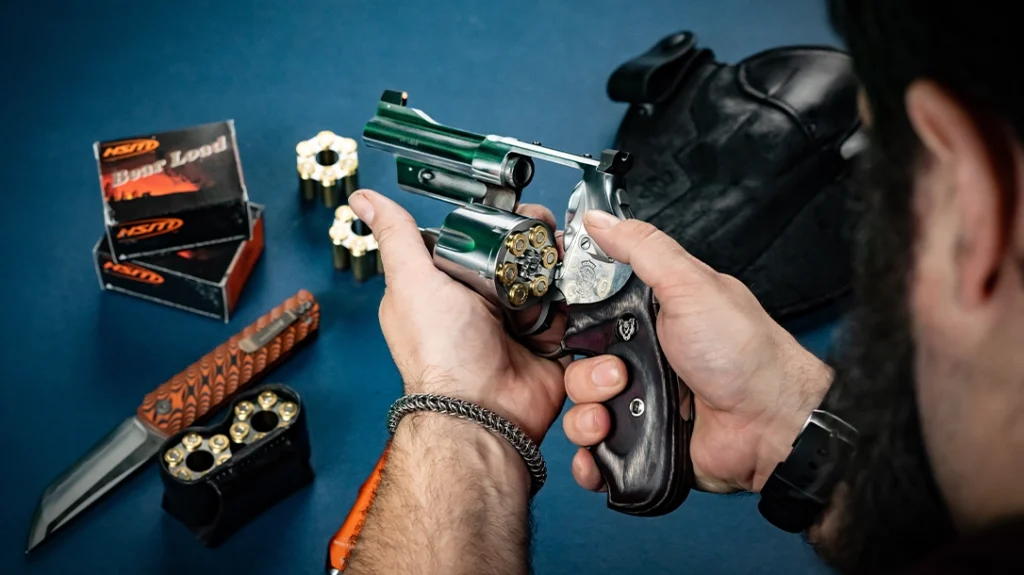
I reached out to Erik at Side Guard Holsters and asked him to build what he believed would carry this platform best. The result was a roughout leather holster with wide-set loops and a reinforced mouth. It distributes weight effectively and keeps the revolver stable against the body. Along with that he also produced a moonclip carrier that increases on-body capacity to 18 rounds.
I have been carrying this revolver through the spring using the Blue Alpha EDC Hybrid belt. With proper placement, belt and a quality holster, it disappears under a t-shirt more effectively than most would expect. This is not theoretical; it’s a concealed-carry N-frame.
On the Range
With the mechanical work complete, the range is the proving ground. With the internal components fitted, the double-action pull settled at 6 pounds, 11 ounces, with full ignition across all tested ammunition. That is a significant improvement cutting factory weight by nearly 3 lbs, while maintaining reliability. The trigger is smooth, consistent, and predictable, thanks to TK’s forged parts.
Advertisement — Continue Reading Below
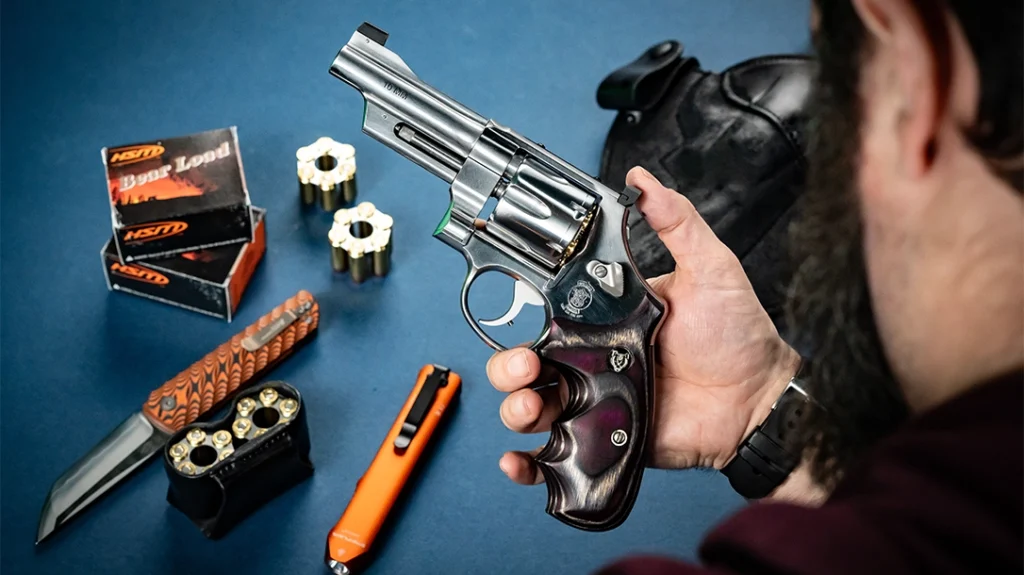
I spent a considerable amount of time shooting this revolver across varying distances and targets. At 100 yards, engaging a USPSA steel target in double action, hits were repeatable. Up close, the platform delivers power in a way that is both manageable and authoritative. This is where the 10mm shines in this configuration. The N-frame absorbs recoil, the bigger grip keeps your hands placed, allowing the shooter to stay in control while still benefiting from the cartridge’s performance.
Performance Data
Using a Garmin Xero chronograph, I recorded the following velocities:
- HSM 180g JHP UHP – 1068.8 fps
- HSM 200g Bear Load – 1067.4 fps
- HOP 180g TMJ – 1130.5 fps
- Wilson Combat 155g XTP – 1312.2 fps
- Wilson Combat 180g XTP – 1197.5 fps
- Wilson Combat TACXP – 1328.8 fps
- Lehigh Defense 115g XD – 1595.5 fps
- Lehigh Defense 190g WFN – 1089.0 fps
- Lehigh Defense 150g XD – 1245.0 fps
- Hornady 150g FTX – 1201.9 fps
- Hornady 200g DGH – 1089.6 fps
- Hornady 135g Monoflex – 1306.1 fps
I chose to carry the HSM Sierra JHP. It offers a balance of velocity, consistency, and terminal performance that aligns with the intended role of this revolver. Landing 2in groups at 50 feet, the ammo is good for the job. Give HSM a try and tell them I sent you.
The Foundation
At this point, it would be easy to say that the Mountain Gun itself has been overshadowed by the modifications. That would be incorrect.
Advertisement — Continue Reading Below
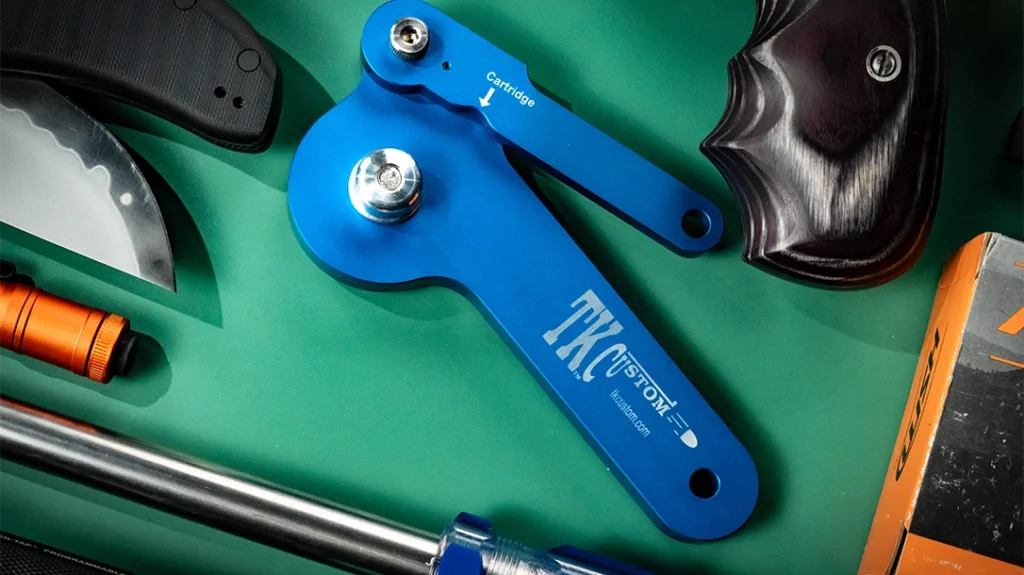
None of this works without a solid foundation. The factory revolver arrived in excellent condition, with proper fit, finish, and baseline function. Without that, this build and other builds like it can’t happen.
The Mountain Gun itself provides the framework. Everything else builds on top of it.
A Controversial Truth
I have said this before, and I will say it again.
Modern Smith & Wesson revolvers are the best they have ever made. Call me a shill if you want.
Advertisement — Continue Reading Below
“I have this great revolver form 1960!”. Yea, me too. Older revolvers survived because they were good. The bad ones are gone. What remains, are the survivors and that creates a skewed perception of past quality. Today’s revolvers benefit from improved metallurgy, tighter manufacturing tolerances, and more consistent quality control across production.
Sure, there have been missteps. Every manufacturer has them. But on aggregate, the current production guns are more consistent than anything that’s come before.
Call it what you want. The data supports it.
Final Cylinder
I hope it’s clear why this platform inspired me to build my own interpretation. The people at Smith & Wesson take pride in what they produce, and that pride shows in how they continue to revisit and refine ideas shaped by the gunsmiths who came before them. This current team is building revolvers that invite work, invite training, and invite evolution, and that’s exactly the kind of gun I want to spend time with. This revolver is my interpretation of what the Mountain Gun can be.
Advertisement — Continue Reading Below
It is not a range toy. It is not a safe queen. Thisis a working gun built for carry, defense, and real-world application.
The combination of the N-frame, the 10mm cartridge, and modern gunsmithing creates something that feels both familiar and entirely new. It is powerful without being punishing. Large, but carryable. It is refined, but unapologetically functional.
This is my Mountain Fighter.
WHY OUR ARTICLES/REVIEWS DO NOT HAVE AFFILIATE LINKS
Affiliate links create a financial incentive for writers to promote certain products, which can lead to biased recommendations. This blurs the line between genuine advice and marketing, reducing trust in the content.