Laser sights have become commonplace on personal-defense handguns and tactical firearms, but in the hunting world, popularity has seen slower growth.
Part of that stems from legality. Hunting regulations governing laser sights and artificial lights vary significantly from state to state. In some areas, laser sights are prohibited for certain game species, particularly big game animals, while other states allow their use under specific circumstances or for nuisance and predator hunting. Hunters should always consult their state’s current regulations before taking a laser-equipped firearm afield.
Hunting With Laser Sights
Traditional optics and iron sights still dominate deer camps and hunting blinds across America. Yet laser sight sales have steadily increased over the last decade, and the same advantages that make them popular for defensive firearms—faster target acquisition, easier aiming in low light, and improved visibility for shooters with aging eyes—can also offer benefits in the field.
Advertisement — Continue Reading Below
Laser sights are not a replacement for good marksmanship, nor are they ideal for every hunting situation. However, in thick cover, dim conditions, and at the shorter ranges where many hunters encounter game, they can provide a practical advantage. The question isn’t whether laser sights work. It’s whether they offer enough benefit to earn a place on your hunting firearm.
Laser Sights for Hunting: Pros & Cons
Among the benefits are more confident target acquisition (particularly in low light); the ability to focus the eyes entirely on the target area, which is beneficial for following the movement of your target animal as well as a great help to aging eyes. The ability to aim the firearm accurately in a “heads-up” manner, rather than with the traditional marksmanship holds we use to shoot with iron sights and scopes. The laser can also be used to point out game to other hunters, and the visual indication of the bullet’s impact point is a constant reminder of the need for safe gun handling and muzzle control.

Advertisement — Continue Reading Below
The downside is that the laser’s maximum range is limited by both its power and (more likely) your eyesight. Laser light is diffused somewhat by humidity in the air (rain or fog). The point of impact is less precise the farther you get from your target, and it can be difficult to spot the laser dot in bright light. Laser sights require batteries and most are not waterproof. Lasers aren’t yet universally legal for hunting in all states, either. Hunters need to check their own state’s specific laws before using them.
Lasers have a definite place on hunting rifles, handguns, shotguns and bows for use on terrestrial animals large and small, as well as fish. Duck hunting, or any other wingshooting, is out though. There’s no way to see the laser dot against the sky to track a bird in flight, and aiming your laser skyward is a threat to civil aviation. In addition, if you are good enough to put a laser on a flying bird, you don’t need a laser sight.
Where They Shine
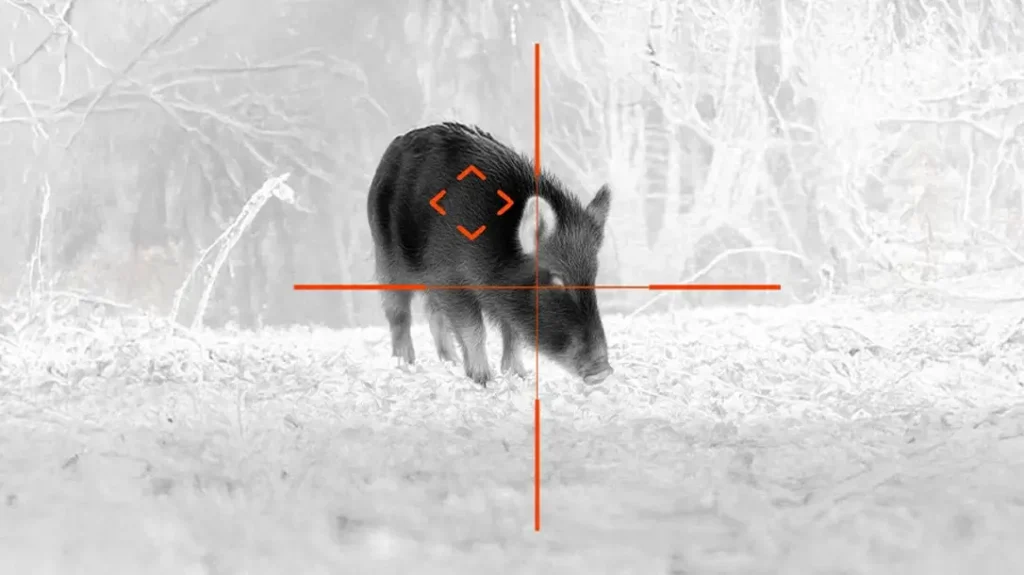
Laser sights can be a significant advantage in the woods, in dimmer light and heavy cover, but lasers also have night hunting applications (for example, for raccoons, foxes and wild pigs) where conventional scopes and sights would be difficult to use. The laser excels on the hunt for terrestrial animals at ranges you would normally shoot with open sights, 100 yards or less.
Advertisement — Continue Reading Below
There’s no magnification or optical enhancement of any kind with a laser sight, only your natural visual acuity and the laser dot. If you can’t see the game with your eyes, a laser isn’t going to help you at all. However, most older hunters don’t have trouble seeing the game. They have trouble seeing the iron sights, and this is where a laser sight shines. Because it puts target and aiming point in the same distant focal plane, it compensates for the loss of close focus that typically affects human eyes as they age.
People under 40, have you ever wondered who’s buying all those reading glasses on display in every pharmacy and big box store? You get farsighted as you get older, and this can make it very hard, if not impossible, to see your rear sight clearly enough to get a good sight picture with open sights. (Aperture sights can still be more or less usable, since the rear sight is supposed to be out of focus anyway.)
Pistol Hunting
Laser sights seem particularly good for pistol hunting, where the ranges are closer. Further, I find that not having to get down on the iron sights or scope in a traditional marksmanship pose allows me to shoot from more comfortable and stable heads-up positions. When you elevate your head over the iron sights, the laser dot appears to rise over them too, and this is one of the advantages of the laser in the field.
Advertisement — Continue Reading Below
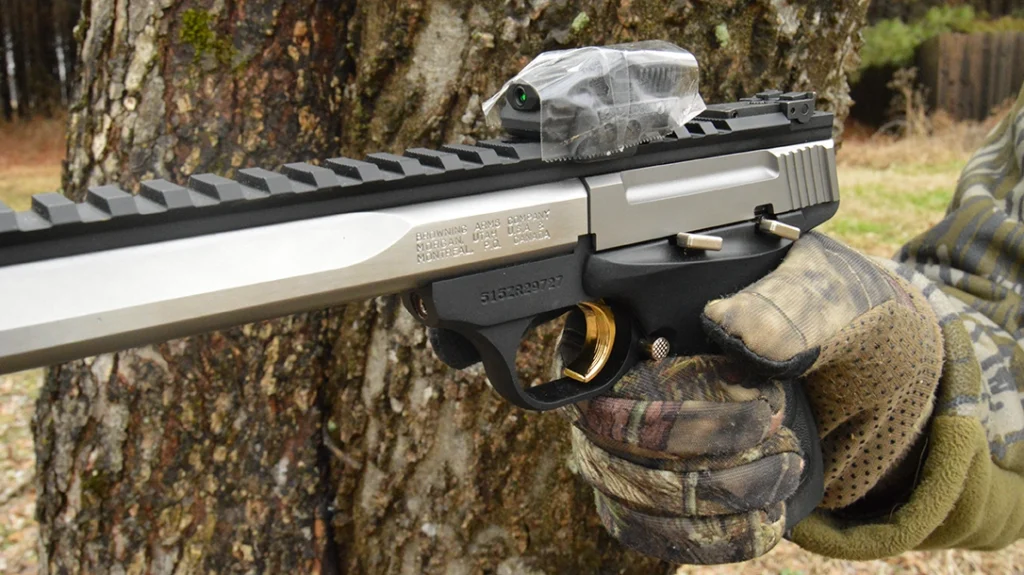
Unlike traditional marksmanship, which concentrates on maintaining perfect sight alignment while taking aim at the target, shooting with a laser sight is all about watching the dot. I’ve hunted squirrels from a seated position resting the barrel on a little Polecat shooting stick with my arms steadied on my knees. Initially, I had a little trouble spotting my laser dot because the trees were bare and a lot of sky was showing. The solution was to aim at the ground in front of me and “walk” the laser right up to the target. It actually takes more time to describe than it does to do it.
Red Or Green?
The color of your laser is important. Red lasers are the least expensive, have the longest battery life and are excellent for close-range defensive shooting. In daylight on the range, I find them hard to spot at 25 yards. The newer green lasers are the best choice for hunters. They really pop out to the eye downrange, even in sunlight. That’s because our eyes see green light wavelengths much better than red ones. The green lasers are more complex to make and retail for about 25 percent more than red. Going green will also use up your battery power about twice as fast, but this is really a non-issue while hunting because there’s no reason to turn the laser sight on until you are preparing to aim your gun. Whether you have two hours or four hours of battery is not going to matter during the course of a season.
Advertisement — Continue Reading Below
Most laser sights are designed to attach to Picatinny or Weaver rails, which is great if you have a tactical rifle, shotgun or pistol. Most traditional (bolt-action) hunting rifles and shotguns will need a rail attached before they can mount a laser. If it’s a newer gun, it’s possible the scope mounts are already attached to small sections of rail screwed onto the receiver. That makes mounting the laser a snap. Take off the scope and rings, mount the laser to the same base, tighten it up and sight in.
Crimson Trace
When it comes to firearm-mounted lasers, Crimson Trace remains one of the most recognized names in the industry. The company built its reputation on laser grips for defensive handguns. Its current lineup includes a variety of rail-mounted lasers and laser/light combinations that can also serve hunters, particularly those pursuing hogs, predators, or other game at close range.
One of the company’s most popular standalone options remains the Rail Master series. Compact and lightweight, these rail-mounted lasers attach easily to firearms equipped with Picatinny or Weaver rails. Green laser models are especially appealing to hunters because they remain significantly more visible in daylight than traditional red lasers.
Advertisement — Continue Reading Below
For hunters who spend time afield after dark, Crimson Trace’s laser/light combinations are often a better fit. Models such as the Rail Master Pro combine a visible laser with an integrated white light, giving hunters a single unit capable of both target identification and aiming. These are useful when hunting raccoons, hogs, or predators where legal.
Beyond Crimson Trace
Hunters looking beyond Crimson Trace have more options than ever before. Viridian Weapon Technologies continues to offer popular models like the X5L Gen 3, which combines a highly visible green laser with a powerful weapon light in a compact package. Holosun has entered the market with units such as the LE420 series, which combines visible lasers, infrared lasers, and integrated illuminators, making them attractive to hunters who use night vision equipment.
For those seeking military-grade durability, Steiner’s DBAL (Dual Beam Aiming Laser) series remains a favorite among serious predator and hog hunters who run thermal or night vision optics. While these systems are often more expensive than traditional hunting lasers, they offer enhanced visibility, rugged construction, and advanced features that make them well suited for demanding field conditions.
WHY OUR ARTICLES/REVIEWS DO NOT HAVE AFFILIATE LINKS
Affiliate links create a financial incentive for writers to promote certain products, which can lead to biased recommendations. This blurs the line between genuine advice and marketing, reducing trust in the content.