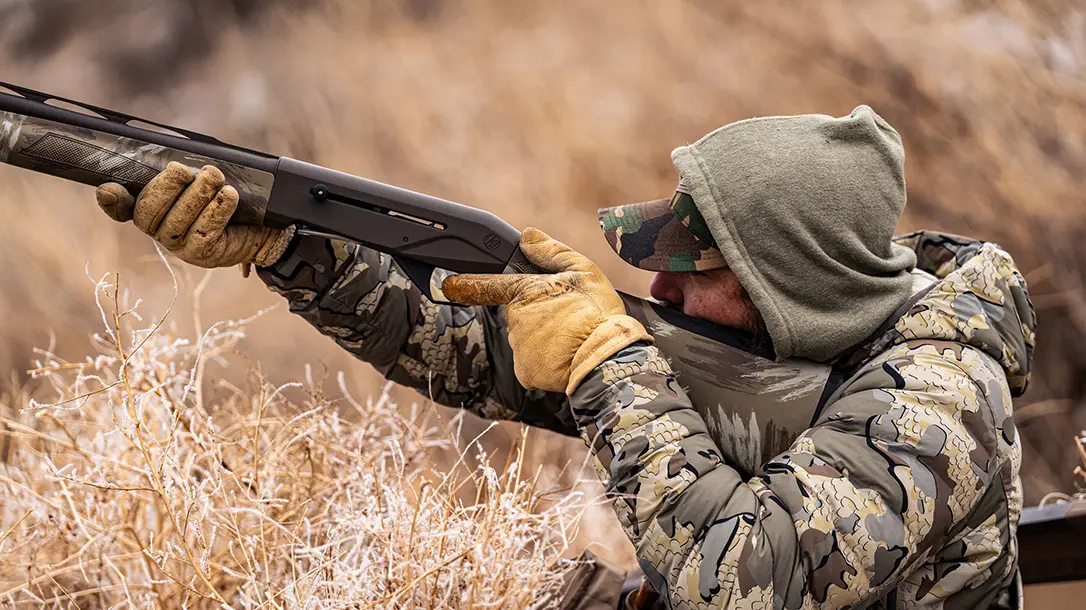
A group of mallards circled the blind and our guide whispered, “Get ready.” It was as though the ducks had read the script. The birds cupped their wings and were setting down right in the decoy spread. “Kill ’em boys!” In a whirlwind, I aimed the shotgun at the drake closest to the bottom of the flock and slapped the trigger. The bird folded.

Weatherby Sorix 20 Gauge Shotgun
A buddy, who was also serving as our guide, had drawn in for a coveted hunt at Otter Slough in the Bootheel of Missouri along the Mississippi flyway with its majestic cypress trees and flooded timber. I was assured most of the shots were going to be over decoys, so a 25-35 yard shot would be the norm.
I was shooting a 20 gauge, which is unusual for me as I normally prefer to bring as much firepower as I can carry. But this hunt was different. After an earlier test of a group of 20-gauge shotguns, I wanted to give one shotgun a more in-depth examination.
Enter the Weatherby Sorix. I know what you’re thinking, Weatherby is a rifle company, and you would be right. Back in 1945, Roy Weatherby started the Weatherby legacy by building rifles chambered in calibers designed by the man himself. Many of them are considered the gold standard in speed and powerful rifle calibers like the .460 Weatherby Magnum and the ever-popular .300 Weatherby Magnum. However, Weatherby has been producing fine shotguns for decades.
Advertisement — Continue Reading Below

Inertia Operated
The Weatherby Sorix 20 gauge is no exception, weighing a mere 6 ½ lbs. This inertia-operated shotgun is a joy to handle in the field. The first go around with the Sorix was a test session at the sporting clays range, busting clay pigeons with 2 ¾” 7/8oz trap loads. It performed superbly, and I found myself attracted to the aggressive loading port and carrier, oversized bolt handle, and oversized operating handle.
While these attributes were noticed on the sporting clays range, it is in the duck blind where the Sorix really shines. The loading port and rolled edges on the carrier allowed for easy loading with the Winchester 3” shells without getting a finger pinched, even with gloves. The oversized trigger guard on the Sorix accommodates even thick gloved fingers to be able to pull the trigger.

Oversized Bole Latch
The oversized bolt latch and operating handle were easy to manipulate. And while on the subject of operating handle, the Sorix has a unique twist on a left-handed shooter perspective known as the SHIFT SYSTEM.
Advertisement — Continue Reading Below
The Sorix is machined on both sides of the receiver, which allows the operating handle to be switched to the left side of the shotgun for a left-handed shooter without the need for a pair of pliers. This SHIFT SYSTEM also allows the safety to be easily switched for a lefty.
The Sorix points and balances very well, with the balance point being at the front of the loading port. The Sorix is drilled and tapped (8-40) for turkey hunters or rifled slug shooters wanting an optic mounted on their shotgun.

Steeped Rib Barrel
The stepped rib barrel and LPA fiber optic sight help the shooter get on target quickly. The barrel is equipped to accept Crio choke tubes. The Sorix is shipped with a convenient choke tube box and four additional choke tubes. The chokes are marked for the type of shot to be used, either lead or steel. The Sorix patterned them all equally well, printing 3” high at 40 yards, which equates to 60 percent of the pattern hitting above the aim point and only 40 percent of the pattern being below the aim point.
I had an opportunity to test a couple of Winchester’s Last Call TSS18 before heading out on the hunt in both #7s and the Winchester’s Last Call Double Shot, a blend of #2 ½ steel and # 9s in TSS. On paper, both patterned very well; however, like many waterfowlers switching over to TSS for the first time, I was a bit over-choked in the blind but was still able to scratch out a couple of ducks.
Advertisement — Continue Reading Below

Trigger
The Sorix trigger broke with some perceived creep at 5 ¾ lbs. The metal on the test shotgun is finished in matte Cerakote. The test shotgun’s stock and forearm were finished in Midnight Marsh. This is a camo finish applied at Weatherby in Sheridan, Wyoming, and each stock is painted by hand. While I do like the pattern, I noticed a few spots where the finish is worn through. This is hardly a detractor, just an observation. Weatherby also features more traditional camo patterns on many of the Sorix models.
The stock features an adjustable stock in the form of shims to fine-tune the fit of the shotgun to the shooter. The stock also features a molded sling swivel stud and a traditional front sling swivel stud in the magazine cap.

Weatherby Sorix
The soft rubber recoil pad did its job, and after firing more than a box and a half of 3” waterfowl loads, my shoulder was not sore, and there was no bruising like shooting a 12-gauge.
Advertisement — Continue Reading Below
The verdict is still out on whether I am ready to switch over to a 20-gauge. I like the weight of the shotgun, and I like how it points. If I do decide to switch, the Weatherby Sorix 20 gauge will be the gun I choose.
For more information, visit Weatherby.
SPECIFICATIONS: Weatherby Sorix 20 gauge (As tested)
| Gauge: | 20 |
| Barrel: | 28 inches |
| OA Length: | 49.00 inches |
| Weight: | 6.5 (empty) |
| Stock: | Synthetic Midnight Marsh |
| Sights: | LPA Fiber Optic |
| Action: | Semi-Auto Inertia operated |
| Finish: | Cerakote matte black |
| Capacity: | 2 + 1 |
| MSRP: | $1649.00 |
Advertisement — Continue Reading Below
WHY OUR ARTICLES/REVIEWS DO NOT HAVE AFFILIATE LINKS
Affiliate links create a financial incentive for writers to promote certain products, which can lead to biased recommendations. This blurs the line between genuine advice and marketing, reducing trust in the content.