Fast-shooting, heavy-caliber lever actions earned their spurs in the Old West, harvesting big game and holding off hostiles with their superior range. The .45-70 Government round still packs its legendary wallop today and lever actions are still hard to beat when it comes to fast follow-up shots and overall rapidity of fire.
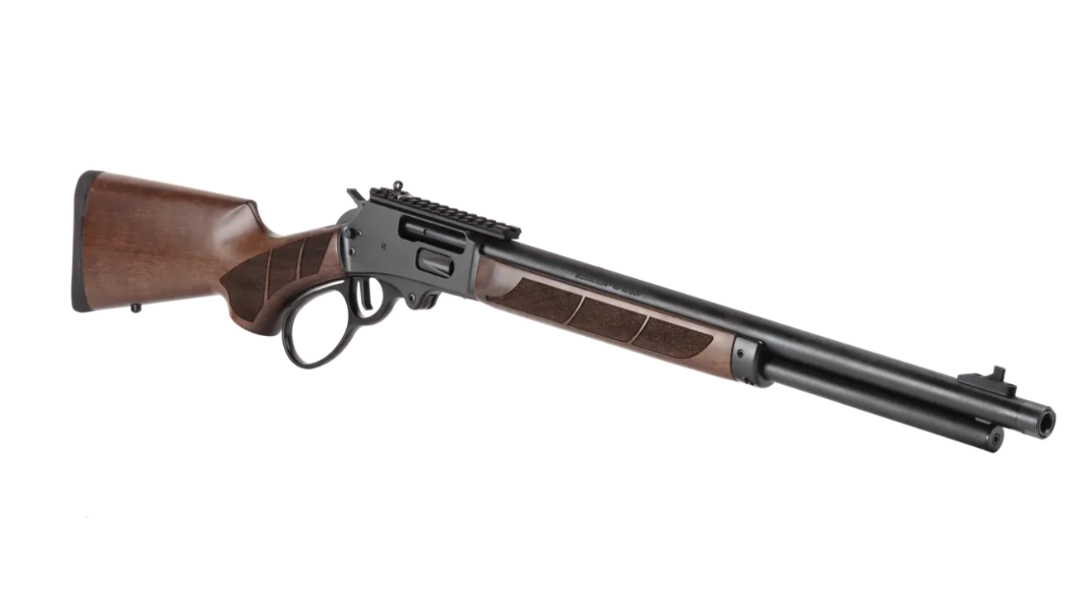
It should come as no surprise this 140-year-old combination remains relevant to modern hunters, particularly for protection against, or the hunting of, dangerous animals. Smith & Wesson’s .45-70 Govt. Model 1854 is their take on the classic Model 1895 Marlin.
Classic Style, Modern Power
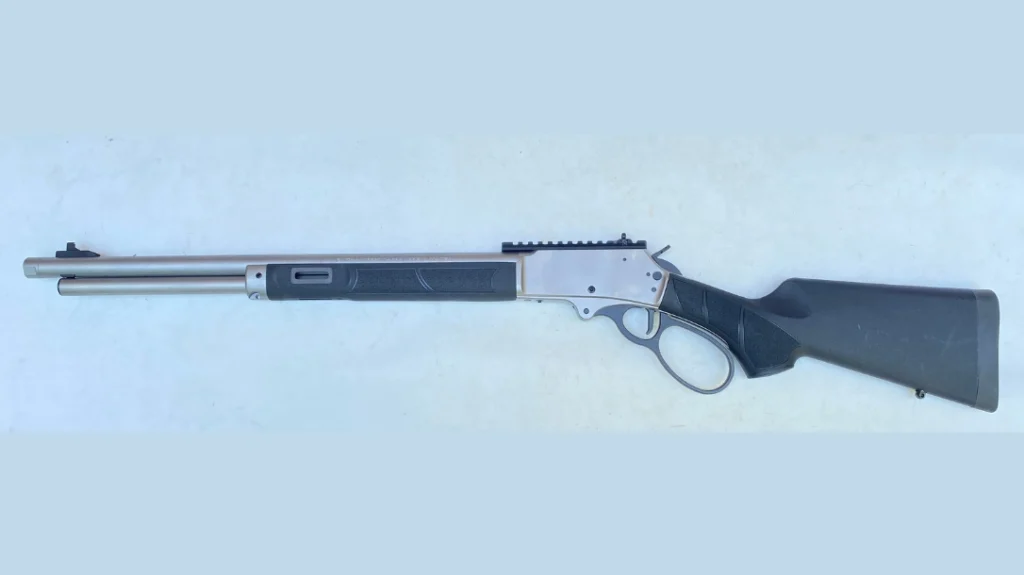
In addition to its smooth cycling and solid accuracy, the Smith & Wesson Model 1854 is well equipped for modern use. It features a threaded muzzle for a suppressor or muzzle brake, an XS Sights adjustable ghost-ring rear sight, and a 5.75-inch Picatinny rail for mounting optics.
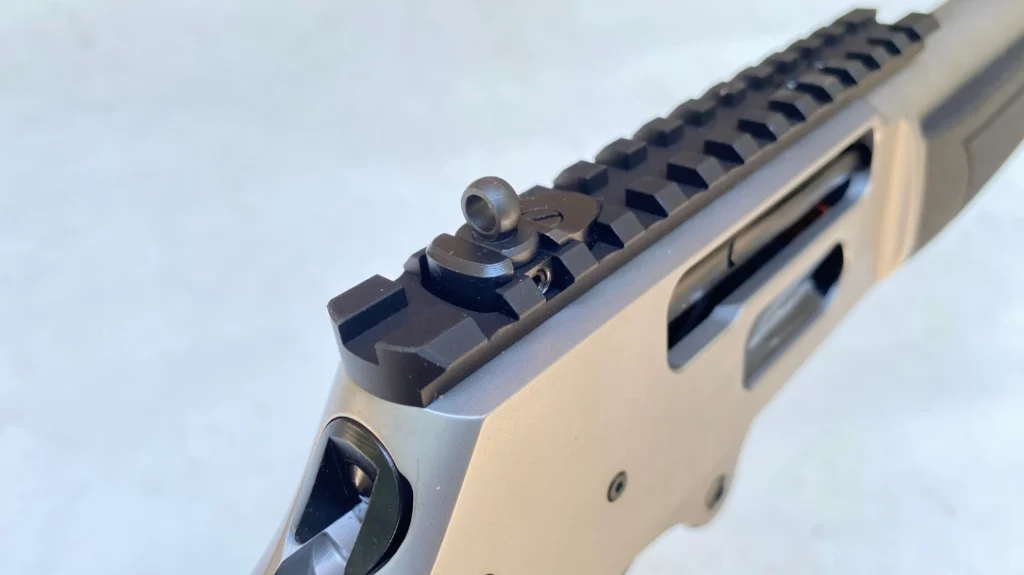
Other thoughtful touches include sling swivel bases, an enlarged egg-shaped lever that accommodates gloved hands, a traditionally styled weather-resistant synthetic stock with stippled grip panels, a soft foam recoil-absorbing buttplate, and three M-LOK slots at the 3, 6, and 9 o’clock positions on the forend for mounting a light or bipod.
Advertisement — Continue Reading Below
Distinguishing Features
There is considerable feature overlap between the Smith & Wesson 1854 and the Marlin 1895SBL in .45-70 Government. How the Smith & Wesson distinguishes itself is with a flat-faced trigger, a shorter and stiffer Picatinny rail, a discreetly modern black synthetic stock with integrated M-LOK, and a classic gold bead front sight. I haven’t tested the Marlin, but I found the Model 1854 thoroughly impressive.
What stood out most was the rifle’s exceptionally smooth operation. Cycling the lever barely disturbed my sight picture, and cartridges fed cleanly through the half-moon loading gate without the hang-ups common to Winchester Model 1886 rifles. Even when run gently, the long .45-70 cartridges chambered and ejected reliably.
I have a deep affection for my 1886 Winchester, but it demands deliberate, forceful cycling to avoid issues. The Model 1854 is far more forgiving and easier to run. While the oversized lever loop can feel slightly sluggish when shooting barehanded, it comes into its own with gloves, eliminating wasted motion and improving overall efficiency.
Setting it Up
The iron sights with their big ghost ring rear aperture are great for quick target acquisition, but not optimal for squeezing the most accuracy out of the rifle and they require a screwdriver to adjust. For testing I mounted a Riton 3-15x 44 Conquer scope with low mounts so I could get a good cheek weld on the comb. To get the scope low enough, I needed to dismount the XS Sights rear aperture. Removing the torx head lever pivot screw was all that was needed to remove the lever and bolt for easy bore sighting. (Be careful not to lose the ejector in the left wall of the receiver.)
Advertisement — Continue Reading Below
I chose a target shooting scope because its graduated reticle offered lots of aiming points to sync up with the .45-70 round’s arching trajectory. In frontier use by the U.S. Army, .45-70 was routinely fired at ranges much longer than those used by modern hunters. Full power hunting loads like Remington Core-Lokt .405 grain jacketed-soft-point can maintain over a 1,000 foot pounds of energy at 300 yards; but expect the massive bullet to drop over 30 inches on the way to the target.
To make field carry easier, I added sling swivels from Brownells and an American-made Triple K Style 60 tan leather sling. At 2.10 inches wide over the shoulder and suede-lined to prevent slipping, it distributes the rifle’s weight well. At $40 MSRP, it’s a solid value for leather of this quality.
Testing Time
I put my targets at 100 yards and set up on the bench with a shooting rest under the handguard and a sandbag under the butt. I set scope magnification to 8x. Conditions were ideal with uniform light and no wind. Like many vintage lever action designs, the trigger on this rifle is a little wiggly and falls forward freely when the muzzle is pointed down. It’s not a defect and I never counted it as take-up since the degree of movement can range from none to a quarter of an inch depending on how the trigger is hanging at the moment you start pressing it. I did like the even fingertip contact the flat trigger face allowed. It broke cleanly at 5.5 pounds. To my delight, recoil wasn’t painful at all thanks to the thick foam buttplate.
Testing Loads
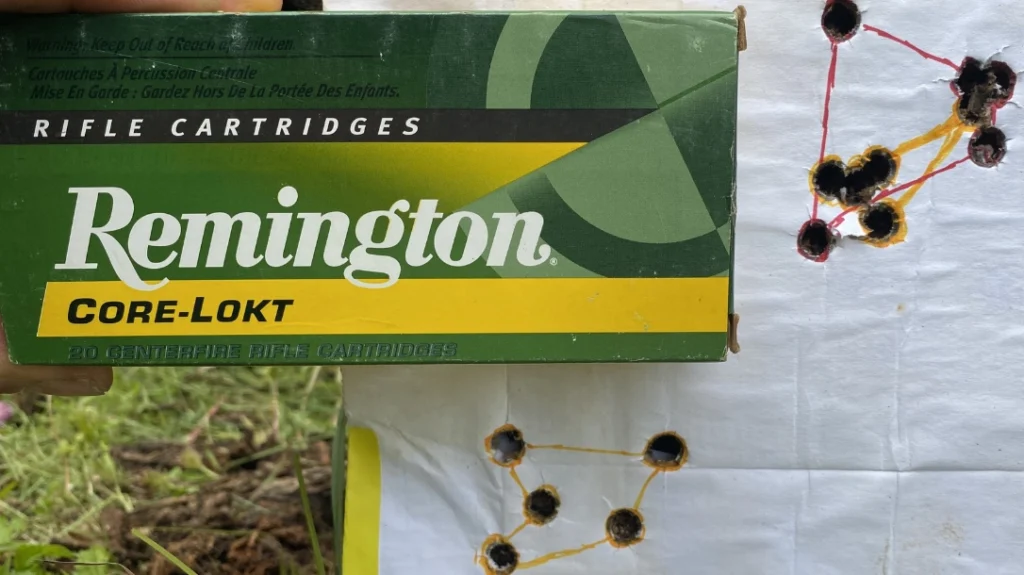
The most accurate of the loads tested was an old-time favorite. The Remington Core Lokt .405 grain full pressure loads averaging five-shot groups of 1.97 inches and 1,575 feet-per-second (FPS). These bullets hammered completely through a 16-inch diameter rotten stump behind the target but by good luck I found one on the ground (quite some distance behind the target) with its exposed soft nose mushroomed out to 0.91 inches at its widest point and 0.82 inches at the smallest. Nearly doubling in diameter is massive expansion. This Core Lokt bullet lived up to Remington’s marketing slogan, “The deadliest mushroom in the woods.”
Advertisement — Continue Reading Below
Hornady LeverEvolution’s 250 grain solid copper Monoflex hollowpoint bullet with its soft elastomer point for safety in the magazine tube and improved aerodynamics averaged groups of 2.25 inches and 1,964 FPS velocity. The wet stump caught five bullets before the others cored a hole through it. Most of the bullets I recovered had their noses petaled back into beautiful flowers that increased their diameter from .72 to .895 inches (a 63 to 97 percent increase from the original .450 inch bullet diameter!).
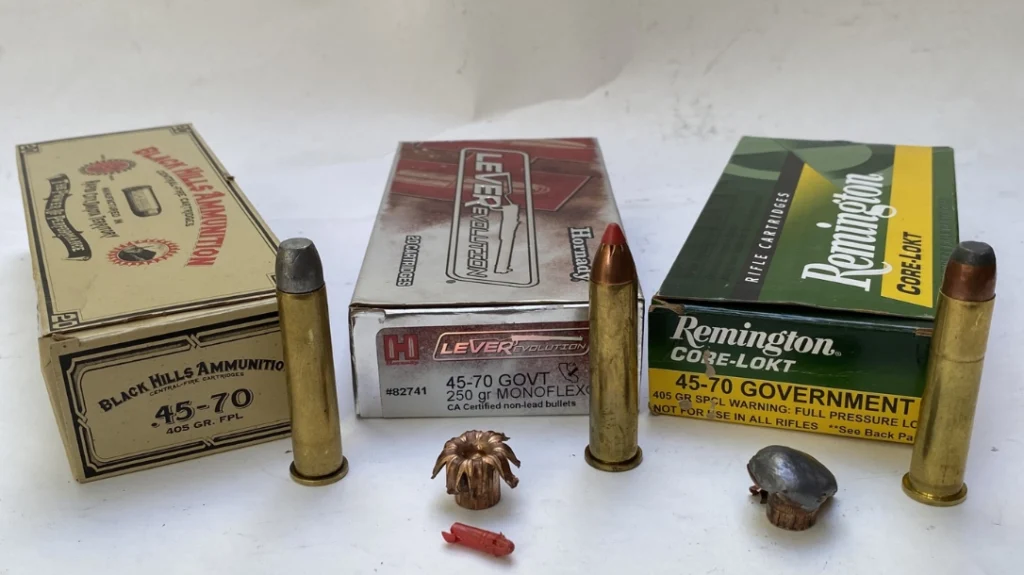
The last load tested was Black Hills Ammunition’s .405 grain hardcast lead cowboy action load that averaged 4.03 inch groups and 1,114 FPS. While still accurate enough for hunting, this load is comparatively short on energy with 1,116 foot-pounds at the muzzle. It’s great fun blasting water jugs and pumpkins.
Smith & Wesson Model 1854 Lever Action: Specifications:
- Caliber: .45-70 Govt.
- Operation: lever action
- Barrel: 20 inch round profile, 410 stainless steel, 1:20” RH twist, 8 groove, 11/16 -24 threaded muzzle with thread protector
- Receiver: forged 416 stainless steel
- Overall Length: 37.8 inches
- Weight empty: 7 pounds 1.6 ounces unloaded
- Capacity: 6+1 rounds
- Trigger: single stage, flat faced, 5.5 pound pull
- Controls: manual cross bolt safety, half cock-notch
- Sights: XS Sights, elevation and windage adjustable, ghost-ring rear, gold bead front post, receiver mounted 5.75 inch Picatinny rail for optics
- Stock: black synthetic, soft rubber buttplate, M-lok slotted front handguard, front and rear sling swivel bases
- Finish: stainless steel, satin matte finish
Performance Testing Results
Performance was tested with a series of five-shot groups fired at 100 yards from the bench with a sandbag rest and open sights. A Competition Electronics Pro-Chrono Digital Chronograph was set 15 feet from the muzzle. Bullet weight is in grains, velocity in feet-per-second and the group size in inches.
| Brand | Bullet Weight (gr) | Bullet Type | Velocity (fps) | Group Size (in.) |
|---|
Advertisement — Continue Reading Below
| Remington Core-Lokt | 405 | JSP | 1,575 | 1.36 |
| Hornady LeverEvolution | 250 | Monoflex HP | 1,964 | 1.85 |
| Black Hills Ammunition | 405 | Hard Cast Lead | 1,114 | 3.59 |
With heavy bullets, the big differences in velocity between these three loads (a 924 FPS spread) translated into big shifts in point-of-impact at 100 yards. At 1,100 FPS, the Black Hills .405 grain bullet load shot the lowest. At 1,575 FPS the Remington Core-Lokt .405 grain bullet struck 6 inches higher. At 2,025 FPS, the Hornady LeverEvolution 250 grain Monoflex bullet stuck 8.75 inches higher than the Remington and 14.75 inches above the Black Hills cowboy action load.
Traditional rear-locking lever actions rarely match bolt guns for accuracy, but the S&W Model 1854 proved to be an exception. It’s an impressively accurate, high-quality rifle. The rifle wears a classic, no-nonsense profile with a non-reflective matte finish on stainless steel. Scoped and fully loaded (6+1) with .405-grain cartridges, it weighs 9 pounds 3 ounces. The 20-inch barrel keeps it handy, though it’s no lightweight.
Advertisement — Continue Reading Below
WHY OUR ARTICLES/REVIEWS DO NOT HAVE AFFILIATE LINKS
Affiliate links create a financial incentive for writers to promote certain products, which can lead to biased recommendations. This blurs the line between genuine advice and marketing, reducing trust in the content.