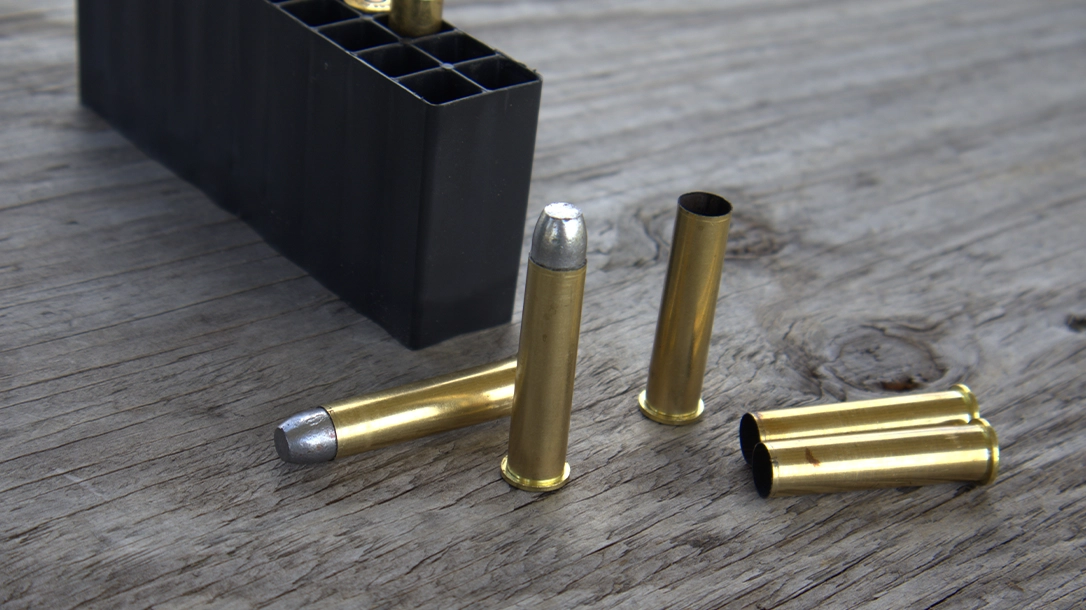
The .45-70 Government cartridge is a popular big game cartridge, particularly in lever action rifles. As loaded today, the round features some of the latest powders and bullet designs. However, when it debuted in 1873 with the Trapdoor Springfield rifle, it was a black powder cartridge that operated at velocities much lower than modern .45-70 ammunition. But even as originally designed, the .45-70 was designed to be lethal for man and beast at a standoff range.
Long before its renaissance in recent years, the .45-70 played a hand in several small wars and was a popular big game round for decades. Black powder .45-70 cartridges are made in limited runs today, mostly for history buffs, cowboy action shooting, and for elderly rifles. Otherwise, it is a handloader’s project. Here is how I load .45-70 Government black powder cartridges and how they stack up on the firing line.
The Original .45-70
After the Civil War, the US Army got by on muzzleloading rifles converted to metallic cartridges, namely the .50-70 Government cartridge. When the all-new Model 1873 Springfield was adopted, an all-new cartridge was also in order. The .45-70 was initially loaded with a .45 caliber 405 grain lead bullet over 70 grains of coarse black powder. This cartridge was smaller in caliber but fired a heavier bullet that bucked the wind and stayed true at ranges beyond the old .50.
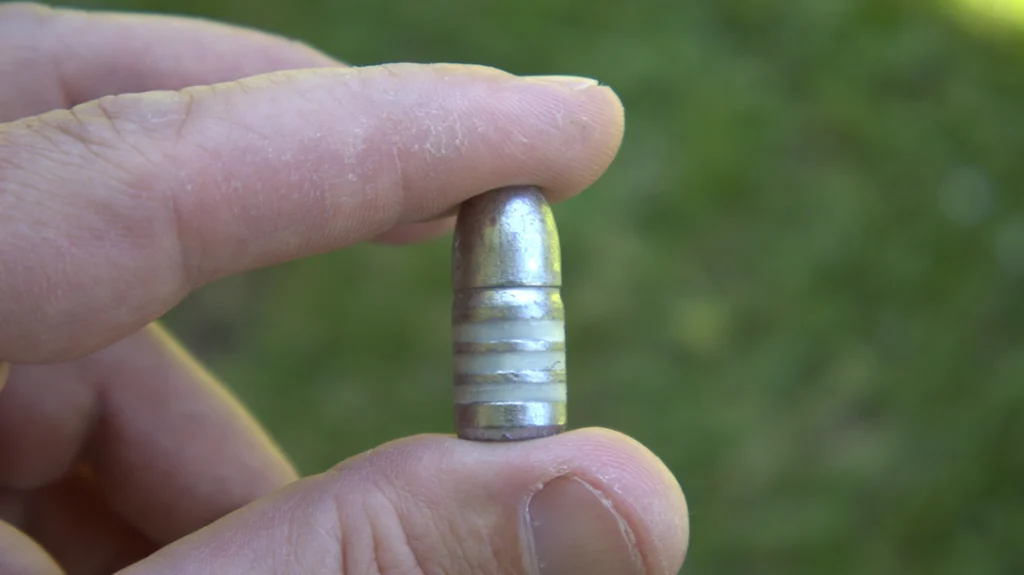
The .45-70 round has changed greatly to meet the need of modern shooters, but even during its service life with the US Army, there were ample changes made to improve performance. The cartridge proved ample with the 30-inch barreled infantry rifle, but recoil was stout with the lighter 22 inch cavalry carbine. In the late 1870s, a Carbine load featuring the same 405 grain bullet and 55 grains of powder entered service. In 1884, with the adoption of an updated infantry rifle, the existing rifle load that used 70 grains of powder was modified to use a longer 500 grain bullet. Together the new Rifle and Carbine loads carried on until the Army went to the .30-40 Krag cartridge in 1892.
Advertisement — Continue Reading Below
Up in Smoke: Specific Considerations for Black Powder Cartridges
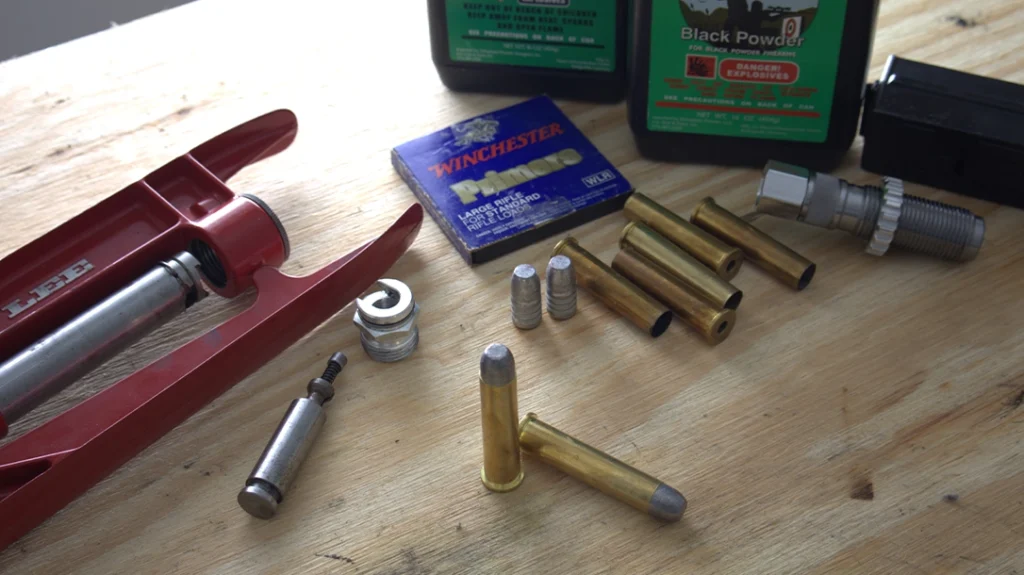
On the face of it, reloading black powder cartridges is little different from smokeless. You will need a basic press and appropriate reloading dies along with bullets, powder, primers, and cases. But with black powder cartridges, there is an asterisk attached to most of these items.
A standard reloading die set includes dies for decapping/ resizing, expanding, bullet seating, and crimping. If you are looking to reload cartridges across different platforms, particularly with magazine fed firearms, a full set is a wise investment. In my case, I am loading for only one single-shot rifle, a Pedersoli Trapdoor Springfield carbine. I opt to not resize my cases but use a decapping pin to knock out my primers and simply flare the mouth to accept a bullet using a powder-thru expander die before following it up with a light run through a crimp die. This ensures smooth feeding in my rifle, but neck-sized only cases may not feed or fit other individual rifles.
Extras You Might Need
Other extras you may need for reloading black powder cartridges are a drop tube and a compression die plug. Depending on the desired load, you may have to compress the black powder into the case to achieve best accuracy and power. Both the drop tube and compression plug assist in this. A drop tube, traditionally made of non-static inducing brass, allows you to feed black powder from a distance into the cartridge. The journey allows for the black powder to settle into the case. A compression die plug is used with the reloading press to physically force powder deeper into the case before seating the bullet.
Some shooters swear by certain components. For example, some will only use magnum large rifle primers in their .45-70 loads. Others swear by a certain brand of black powder. Swiss is more powerful and cleaner burning than Scheutzen and Goex, but the latter brands are often more available. The biggest factor in getting the right components is getting the right granulation and using bullets with ample grease grooves.
Advertisement — Continue Reading Below
There are several grades of black powder ranging from coarse to fine: Fg, FFg, FFFg, and FFFg. Some shooters use FFFg in everything, but it is more efficient as a pistol powder, while Fg musket powder takes up too much space in smaller cases. In .45-70, FFg is bog standard but going one degree to the left or right can work.
Lastly, you will need to select a bullet or bullet mold that offers ample grease grooves. Without lubrication, black powder fouling hardens quickly and will reduce your accuracy. There are bullet molds specifically designed for black powder cartridges called Big Lube molds. In the absence of that, getting as many grease grooves in the bullet and using the appropriate lube is vital. Another lube option is to use a grease cookie. A grease cookie is used for additional lubrication and is cut by pressing the case mouth into a pan of lube before the bullet is seated over it. The cookie sits on a paper or cardboard wad that keeps the lube from infiltrating the powder.
Slug It Out
Another overlooked aspect of reloading black powder cartridges is the need to slug your bore. Since black powder cartridges generally use cast or swaged lead bullets, they will need to be the proper size for the bore. With bullets that are left unsized or are sized too large, you may not be able to insert the cartridge into the chamber. Bullets that are too small can cause accuracy problems.
A simple way to slug the bore requires a caliper, a long dowel, and an over sized lead slug relative to the bore. The slug is then forced down the bore and swaged to size. The slug is then measured, and you have the bore diameter required for best use.
Case Prep
The .45-70 cartridge case is a large straight wall case that is easy to manipulate and reload. To start, I case prep by trimming the brass to its factory overall length of 2.1 inches. Trimming the cases is not strictly necessary all the time as the .45-70 is a low pressure cartridge, but left alone for too many cycles and longer cases may fail to seat in the chamber or may cause higher operating pressures. Further case prep can be done with water and a brush as the corrosive salts left from black powder residue are neutralized by water. No special solvents required.
Advertisement — Continue Reading Below
Loading
Decapping .45-70 brass is simple with a run through the decapping/resizing die of the reloading press. This knocks out the dead primer and brings the cartridge case back to factory shape. These large cases demand a small amount of case lube. I use Hornady Unique case lube for the task, but any will suffice. Since I am using a single shot rifle, I can get away with using a decapping rod and neck-sizing the cases later on.
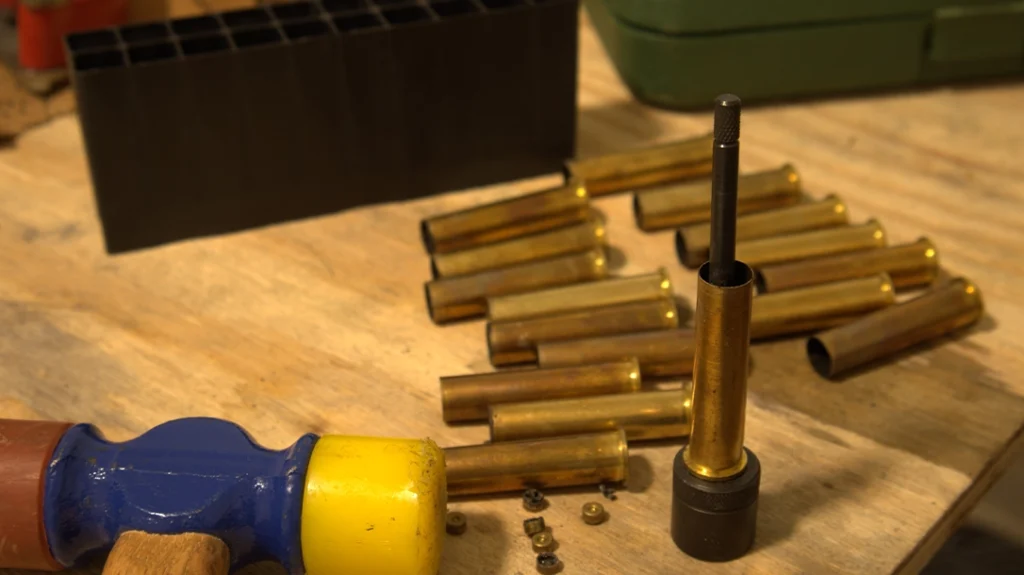
Use your favorite priming device to prime the empty case with a fresh primer. In conjunction with my Lee Hand Press, I use a Lee Hand Prime unit that mounts at the top of the press with the anvil mounted in the arm. I use standard Federal large rifle primers. As mentioned, some shooters demand magnum rifle primers, but in my experience it is not necessary.
With smokeless rounds, the next step would be to run the round in the powder-thru die, which sizes the neck of the case for a bullet and allows you to pour the powder charge. Instead, I run the case through the die to flare the mouth and then dump powder through my drop tube to charge each case. There are several makers of brass drop tubes, but mine is a homemade rig made of copper. The longer the tube, the more even the distribution. My tube is 24 inches long.
After charging each case, you can elect to place a wad and grease cookie over the case mouth. You can also elect to run the charged case through the compression plug. The plug I chose is for a .45 caliber rifle and is offered by Track of the Wolf. It fits inside the powder-thru die and the amount of compression can be adjusted by backing out or threading in the outer die and adjusting the stop collar to match so the die holds its setting.
Advertisement — Continue Reading Below
It is worth noting that some powders compress better than others, but under most circumstances, only light compression is necessary. This eliminates any air gaps and keeps powder from moving about in the case. In my view, larger granulations are easier to compress and both Goex and Schuetzen compress more readily than higher quality powders from Swiss.
When properly compressed, the bullet of choice should seat with hand pressure, though you can elect to use the bullet seating die. The latter is handy for magazine-fed rifles. On the other hand, it is easy to get carried away by compressing too much in order to get a prescribed amount of powder in the case. This can cause bullet deformation or case failure in the pressing process.
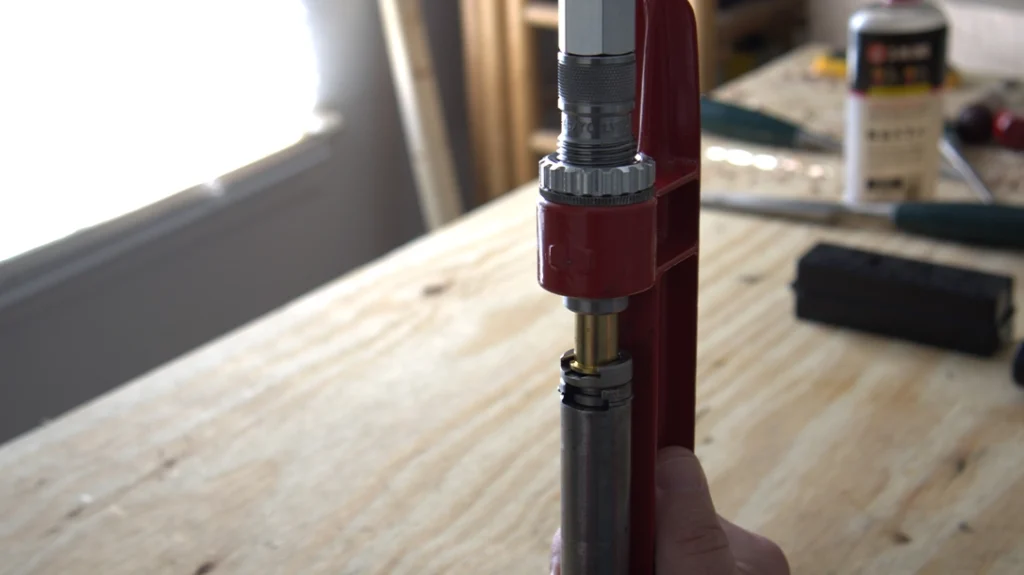
After the bullet is seated at its cannelure, a run through a crimp die reforms the case mouth. A light roll crimp or no crimp at all is fine for a single shot. A little more is called for if you are using a magazine rifle. With that last step, you now have black powder cartridges to test and use.
Advertisement — Continue Reading Below
Field Testing
There are many variables that go into black powder reloading, and reloading more generally. What works best ultimately will come down to sticking to safe reloading practices, a good manual, and finding what gives the best accuracy and performance.
I loaded two different period loads for the .45-70 Government cartridges. The original 1873 load, which used a 405 grain lead bullet backed with 70 grains of black powder was loaded. I also recreated the carbine load adopted by the US Cavalry in the latter part of that decade. It retained the 405 grain bullet but with a 55 grain powder charge. I loaded both cartridges with and without grease cookies and using Fg, FFg, and FFFg Schuetzen powder to test each variable. The bullets used was a .459 inch diameter Acme bullet that was pan-lubed with my preferred black powder lube—1 part beeswax and 1 part olive oil. The rifle used is a Pedersoli 1873 Trapdoor Springfield carbine with a 22 inch barrel.
Results
In terms of velocity, more powder and compression is the rule. But not all powder performed the same. I was able to compress 67 grains of FFg blackpowder in these modern cases or 64 grains using a grease cookie. This load achieved an average five-shot velocity 1,404 feet per second at max charge. The FFFg and Fg loads yielded 1,218 and 1,147 feet per second. The flame was not catching the compact and fine FFFg powder and some of it was burning up beyond the muzzle. Interestingly, the same proved true for the big Fg granules under compression. Recoil was sharp, but not painful.
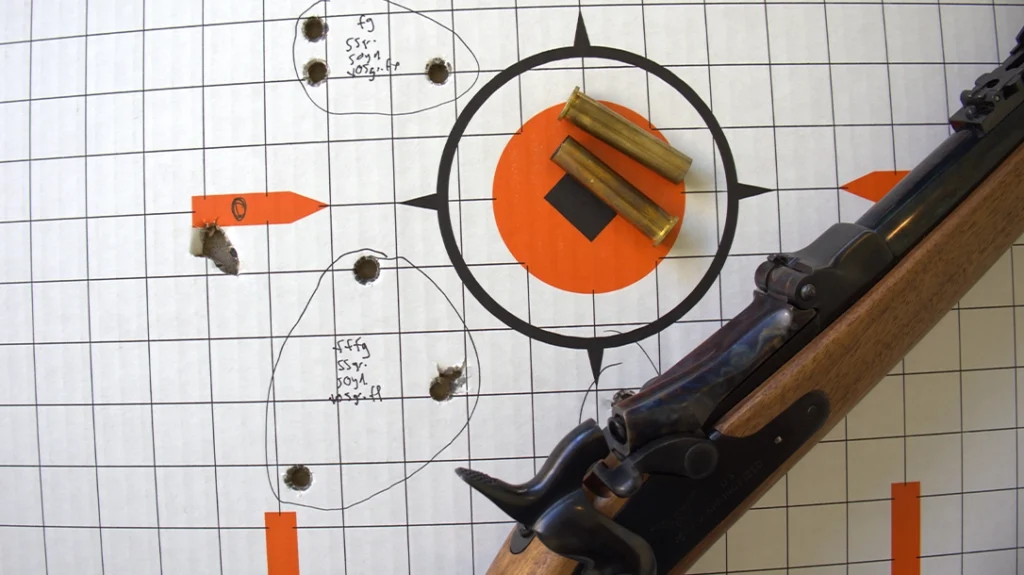
The 55 grain Cavalry load, reduced to 52 grains with a cookie, was a joy to shoot and the most accurate load. This load required no compression with any powder and the bullet was seated easily on top. The Fg load was sedate on the shoulder and had an elliptical trajectory. It was traveling just 911 feet per second and struck six inches lower than my point of aim at 50 yards.
Advertisement — Continue Reading Below
A three-shot group clustered at 2.3 inches. The FFg load came in at 1,014 feet per second and was consistent. As it happened, the ten-shot averages between the FFg and Fg loads was only 34 feet per second. The FFFg load had an extreme spread of 81 feet per second, but yielded the highest velocity: 1,101 feet per second. That velocity is right in the ballpark of the original load.
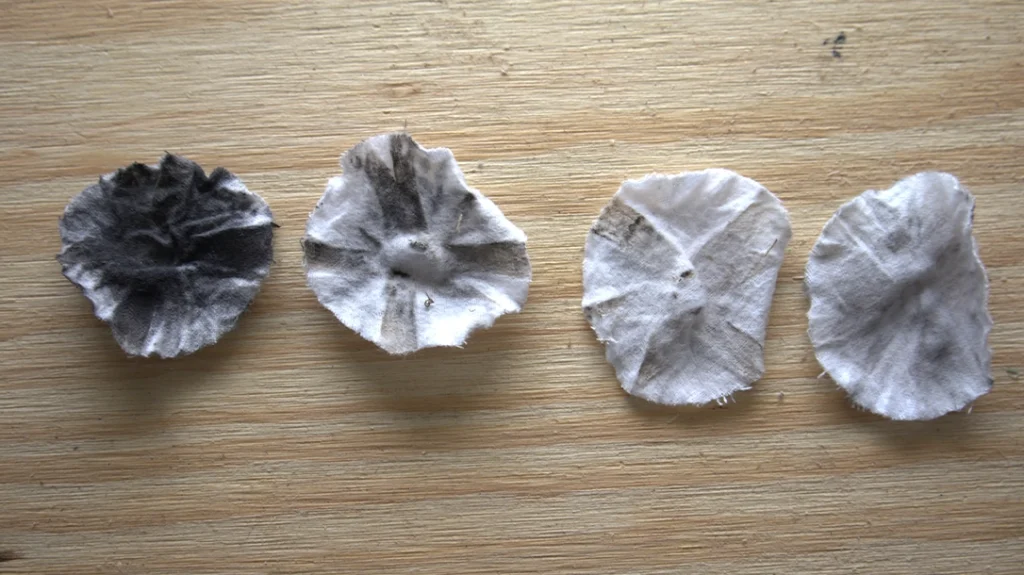
The Cavalry load using FFFg powder was slightly sharper on the shoulder and shot just two inches low at 50 yards. The group did open up to 3.3 inches, however. In terms of long-term accuracy after repeated firing, the use of a grease cookie did not enhance or degrade the experience as the Acme bullet had ample surface area. Cleanup of the soft fouling is easy. After a box of twenty rounds, four damp patches was all it took to get back to a clean bore.
Black Powder .45-70 Cartridges: Fun, Economical, Effective
The .45-70 Government cartridge is big in personality and in the recoil department. Its utility and power capacity has allowed it to outlive most of its contemporaries. Whether you are using a single-shot, a lever action, or a massive revolver, the .45-70 has plenty to offer. For the reloader, the round is even more scalable. You can go for a flat-shooting smokeless load with modern jacketed ballistic tip rounds. Conversely, you can go back to black powder. Loading black powder cartridges requires some additional attention, but it brings the old .45 back to its basic form. You get plenty of smoke, less of a hit on the shoulder, and a big bullet that punches harder than the chronograph suggests.
WHY OUR ARTICLES/REVIEWS DO NOT HAVE AFFILIATE LINKS
Affiliate links create a financial incentive for writers to promote certain products, which can lead to biased recommendations. This blurs the line between genuine advice and marketing, reducing trust in the content.
Advertisement — Continue Reading Below