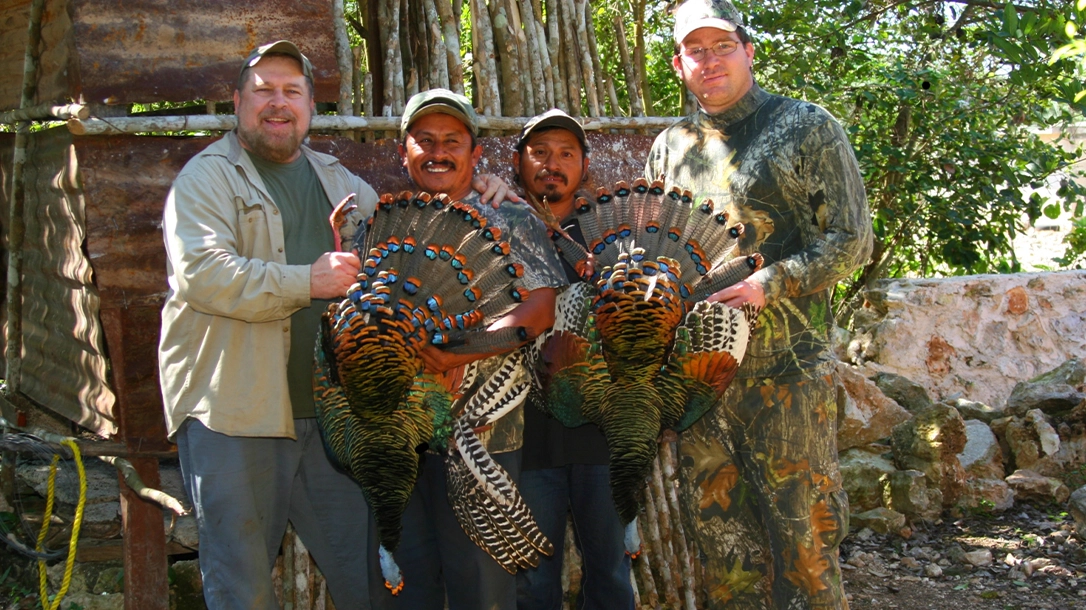
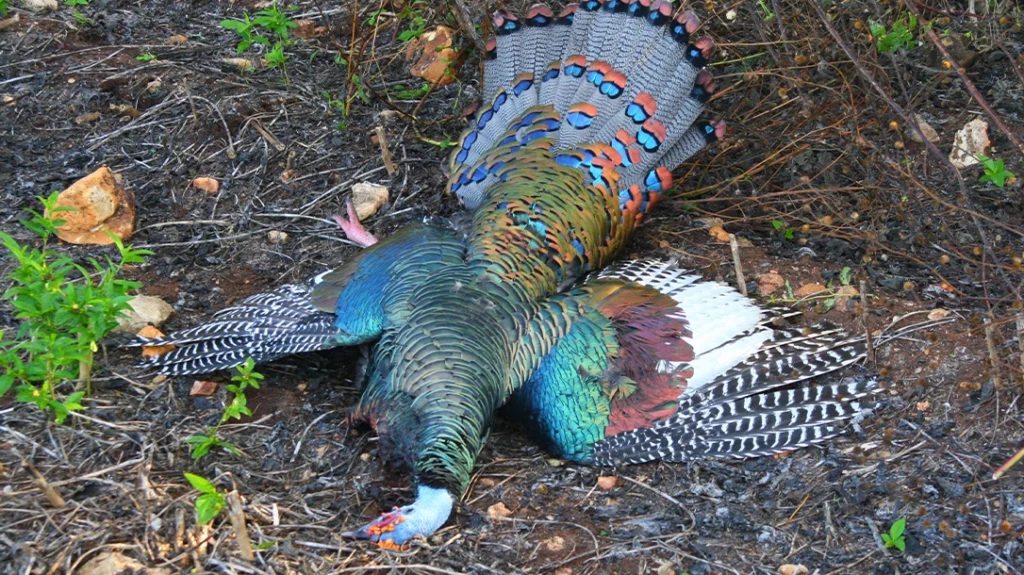
I was a stranger in a strange land. I was 2,300 miles from home sitting in a makeshift blind in the Yucatan Peninsula, home to the Ocellated turkey. It’s a cousin to the North American turkey, but it is no ordinary bird. With an iridescent blue body that resembles chromalusion paint typically seen on cars, its color changes as it moves and the turkey’s blue head is mottled with gold-colored warts. While most male turkeys gobble, the Ocellated sings.
My guide Marcos spoke no English, while I spoke no Spanish. I picked up a couple of key words, the most important being pavo, or turkey. In the sticky Mexican mornings, I swatted mosquitoes as big as hummingbirds, waiting for pavo.
In Pursuit of the Ocellated Turkey
On our first venture out, no birds came in range. The next morning, I followed Marcos through the edge of a field when he motioned for me to stop. Though it was still dark, Marcos’ headlight disappeared into the jungle. Soon I could hear his ever-present machete and the occasional flash of his light as he cut a path and built a new blind. Ten minutes later he reappeared from the darkness and motioned for me to follow him.
We took our familiar positions next to one another, and I enjoyed the sounds of the forest waking up as daylight crept into our blind, and the freshly harvested field was once again our focus. As the morning crawled by, the plane ride, too little sleep, and the huge 3am breakfast began catching up with me, and I dozed off. Suddenly I heard Marcos’ whispering “Pavo.” I wiped my eyes of the sleepiness, but I still couldn’t see anything. He whistled, imitating a hen, and almost on cue just as the sun hit the field, pavos appeared.
Advertisement — Continue Reading Below
Twenty birds were feeding but I couldn’t see any gobblers. As the birds roamed, picking at the ground, Marcos whispered “Senor” and pointed to where the jungle and fields met. Sure enough, three male birds were working toward our blind. I watched as they got closer and closer to us. Finally, Marcos nodded. I slowly raised the shotgun to my shoulder, put the bead on the closest bird’s head, and slapped the trigger. Marcos rushed out of the blind and immediately ensured my bird was dispatched. My first Ocellated turkey.
Jungle Method
The jungle method is the most commonly known method. The night before a hunt, the guides will locate turkeys as they fly up to the roost and listen for singing gobblers. The next morning as daylight creeps in, the hunting party make their way as quietly as they can through the thick, rough terrain following the sound of the singing birds. The window of opportunity is very short.
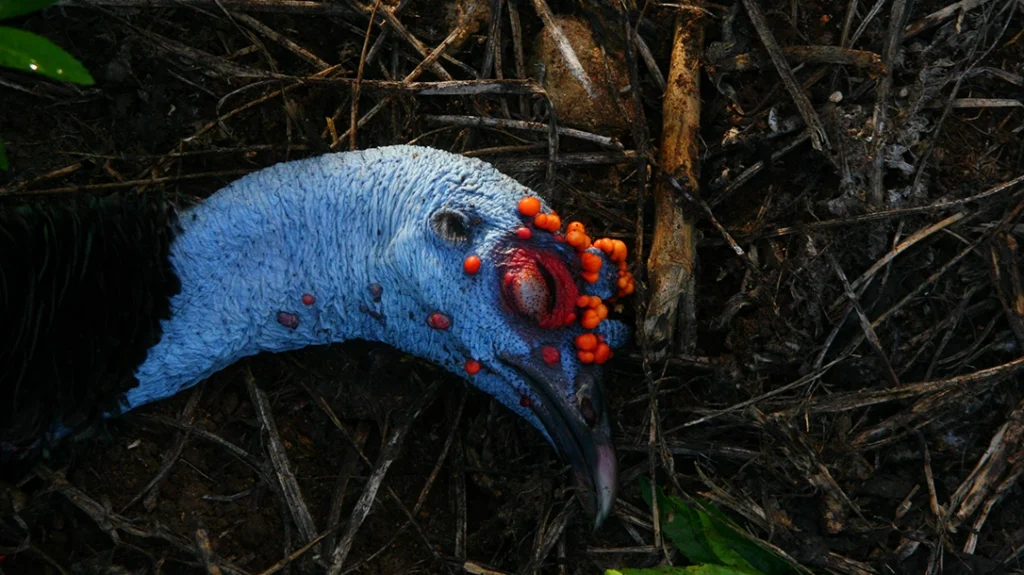
It is imperative to get as close to the birds as possible without spooking them off the roost. Once they fly off the roost and land in the jungle, they disappear. Since Ocellated birds are harvested from their roost, they’re difficult to bring down from the trees as their head and vitals are protected by the lower part of their body. For this reason, many outfitters supply their hunters with large sized shot like #2s.
Water Holes
Sitting over water holes is the simplest and oldest method of hunting. Hunters sit and wait for a turkey to drink. While the birds must drink daily, it is sometimes only a hopeful wish they would come into the watering hole you are sitting over, yet many Ocellateds are taken this way.
Advertisement — Continue Reading Below
Ag Fields
The third method of hunting these turkeys is watching the agriculture fields. The guides build makeshift blinds near the ag fields to observe the turkeys’ routine of feeding, picking up left over grain or insects. It too is a waiting game. It is recommended to carry good insect repellant or a ThermaCell. While the Ocellated are not large in size, the mosquitoes are gigantic.
Calling
It was thought the Ocellated turkey couldn’t be called to the gun, but with modern technology hunters have recorded the “singing” of the Ocellated gobbler and played it back through their Fox Pro caller, and found the birds respond well. Today, calling in the Ocellated turkey in the edges of the jungle is one of the most popular methods of hunting.
Tips from an Outfitter
Most Ocellated turkey hunts are booked through an outfitter in the US.
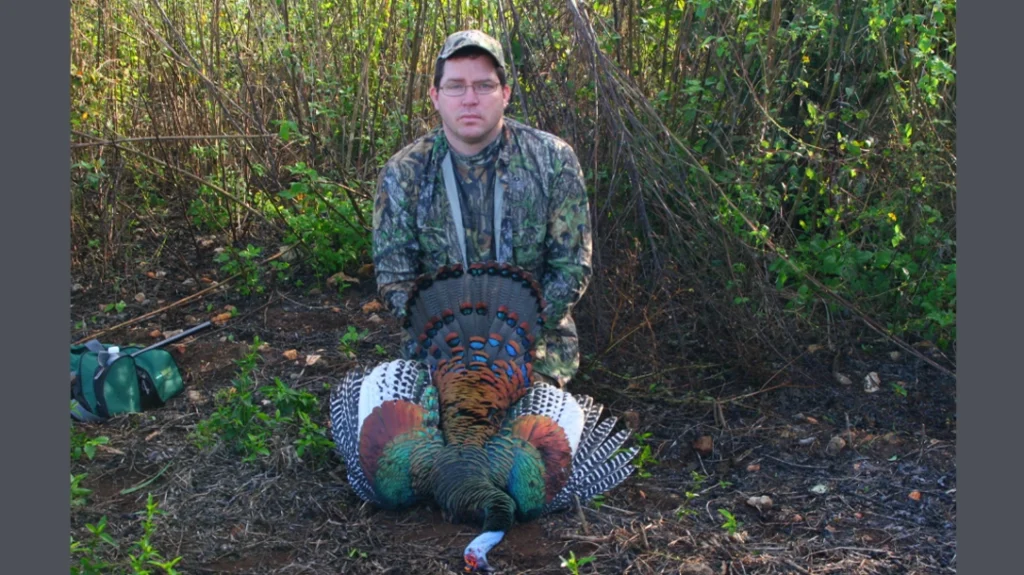
Hunters cannot bring their own firearms or ammo into the country without going through a mountain of paperwork. While I was hunting in Mexico, I used an old Remington 1100 that had seen better days, loaded with #2s, no doubt a carry-over from the tree hunting days. Most outfitters today are equipped with modern shotguns and modern TSS ammo.
Advertisement — Continue Reading Below
Ted Jaycox of Tall Tines Outfitters recommends going through all your gear to ensure there is no ammo in your vest or even empty shells. Being held up at customs is a sure way to ruin your hunt.
Bringing Your Trophy Home
There is a process bringing your trophy home. Most reputable outfitters handle all the paperwork and shipping for you, and your trophy will be sent directly to a USDA certified taxidermist.
Transportation
Part of the outfitter’s duties is to handle all transportation, from Merida airport to camp and back again.
Is it Safe?
Jaycox has been hosting hunters for the Ocellated for more than a decade and says none of his hunters have ever felt uncomfortable while in Mexico, even as recently as January of 2026 when the violence began heating up. He begins his hunts at the end of January and runs through April.
If you are looking to achieve your world slam, the Ocellated turkey should be high on your list.
Advertisement — Continue Reading Below
WHY OUR ARTICLES/REVIEWS DO NOT HAVE AFFILIATE LINKS
Affiliate links create a financial incentive for writers to promote certain products, which can lead to biased recommendations. This blurs the line between genuine advice and marketing, reducing trust in the content.